
A house fire can create several restoration problems in a matter of minutes. Flames and heat may damage building materials, but the effects often reach much farther. Smoke and soot can move into rooms that never burned, while water from fire hoses or sprinkler systems can soak flooring, drywall, insulation, cabinets, framing, and belongings.
For a Nashville homeowner, the hours after a fire can bring questions almost as quickly as the damage itself. What can be restored? Where did the smoke travel? How should the loss be documented for insurance? How much could professional restoration cost, and what happens when heat affects structural materials?
Commercial property owners, managers, insurance agents, adjusters, carriers, and referral partners face many of the same questions, particularly when a fire affects apartments, offices, restaurants, retail properties, schools, healthcare facilities, or other occupied buildings.
Rytech Restoration of Nashville provides 24/7 property damage restoration throughout Nashville, Davidson County, and surrounding Middle Tennessee communities. The local team combines IICRC-certified technicians, advanced inspection and restoration equipment, detailed project documentation, insurance collaboration, and a restoration-first approach designed to preserve affected materials whenever they can be successfully restored.
Here is what Nashville property owners should know about the fire damage restoration process.
What Are Common Causes of Fire Damage in Nashville Homes?
Cooking remains one of the first places to look when thinking about residential fire risk. Grease, overheated cookware, combustible materials left near burners, and unattended cooking can turn an ordinary meal into a fast-moving property loss. Heating equipment, electrical problems, overloaded circuits, smoking materials, candles, dryers, fireplaces, and malfunctioning appliances create other common ignition sources.
Nashville's changing seasons add another consideration. Cold weather can increase the use of fireplaces, portable heaters, and other heating equipment. Tennessee's Department of Commerce and Insurance has specifically reminded residents to keep combustible materials away from fireplaces and space heaters and to maintain working smoke and carbon monoxide alarms during cold weather.
Property layout influences what happens after ignition. Nashville and Davidson County contain historic homes, brick houses, wood-framed construction, crawlspace homes, newer subdivisions, apartments, townhomes, high-rises, and commercial buildings. A fire that begins in one room can send smoke through stairways, halls, attics, wall openings, and mechanical systems.
Alec Bailey and the Rytech Restoration of Nashville team bring years of restoration-industry experience to these local conditions. Published Rytech Nashville material describes experience working in historic Nashville homes, modern commercial facilities, crawlspace construction, hardwood flooring systems, and properties throughout Davidson County and surrounding Middle Tennessee communities.
“Over the years, our team has worked in everything from historic Nashville homes to newer wood-framed properties, crawlspace construction, multifamily buildings, offices, retail spaces, and modern commercial facilities throughout Davidson County and Middle Tennessee. After a fire, we are not looking only at the room where the flames occurred. Smoke, soot, odor, heat, and firefighting water can follow completely different paths through drywall, wood framing, hardwood flooring, insulation, masonry, and mechanical systems. Our experience with local building materials helps us follow that damage and identify what can be successfully restored before unnecessary materials are removed.”
Alec Bailey, Owner, Rytech Restoration of Nashville
That wider view becomes the foundation for the restoration decisions that follow.
What Should I Do Immediately After a Fire?
Personal safety comes first. Leave the property, account for everyone, contact emergency services, and follow instructions from the Nashville Fire Department or other responding authorities. Do not return to the building until emergency officials have released it for appropriate access.
Once the property can be accessed, contact your homeowners insurance company or agent and a professional restoration company. Tennessee's Department of Commerce and Insurance advises property owners to contact their insurer as soon as possible, photograph or record damage, keep damaged property available for the adjuster when possible, and save receipts associated with temporary measures and other covered expenses.
Document conditions before extensive cleanup begins. Photos and video can capture damaged rooms, furniture, appliances, flooring, electronics, personal property, and other contents. Those records give the homeowner, restoration team, agent, adjuster, and carrier a clearer picture of the loss.
Avoid treating soot like ordinary household dust. Aggressive wiping can spread residues or push them farther into certain materials. A professional assessment allows technicians to identify what burned, where smoke traveled, which materials were affected, and which cleaning procedures fit the conditions.
Rytech Restoration of Nashville is available around the clock for property damage emergencies at (615) 751-8445.
How Is Fire Damage Assessed and Inspected?
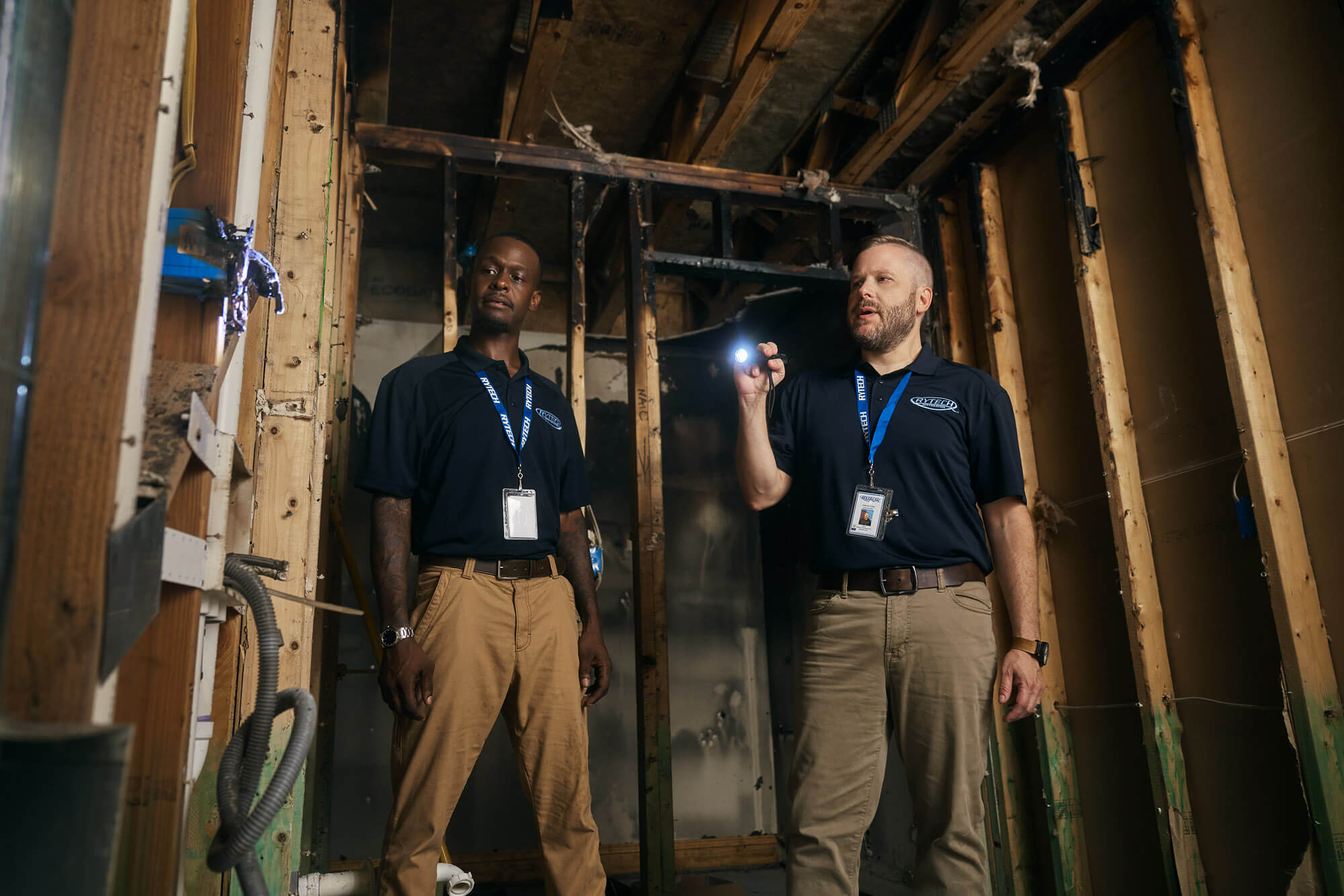
A professional fire damage inspection goes beyond the visibly burned room. Technicians evaluate fire and heat effects, smoke and soot distribution, odor, affected contents, building materials, possible HVAC involvement, and water introduced during firefighting.
Picture a kitchen fire in a two-story Nashville home. The flames may remain around the cooking area while heated smoke travels into a hallway, stairwell, upstairs bedrooms, attic, or HVAC pathways. Firefighting water can take another route, moving beneath cabinets, through flooring, inside wall assemblies, or into rooms below.
When water becomes part of a fire loss, ANSI/IICRC S500 provides a professional framework for identifying its extent. The standard calls for restorers to determine and document water migration using appropriate moisture-detection equipment. Equipment may include moisture sensors, thermo-hygrometers, invasive and non-invasive moisture meters, infrared thermometers, and thermal imaging cameras.
S500 also directs restorers to inspect adjoining rooms because water can travel underneath walls or originate from areas above even when the flooring surface appears dry. The initial inspection considers pre-existing conditions, affected materials, customer concerns, building occupancy, water migration, dry standards, and drying goals.
That level of documentation benefits everyone involved. Property owners understand what was found, while agents, adjusters, carriers, and property managers receive a clearer record of the conditions being addressed.
How Do I Start an Insurance Claim for Fire Damage?

Contact your insurance company or agent and report the fire as soon as practical. Have your policy information available and provide the date of loss and basic details about what happened.
Tennessee's Department of Commerce and Insurance recommends taking photographs or video, maintaining records of damaged personal property, keeping receipts, and asking the insurance company what forms, documents, and information it needs. The department also recommends maintaining a home inventory because photographs, videos, and records of major purchases can make documenting a future claim easier.
Coverage depends on your individual homeowners policy. Deductibles, policy limits, dwelling coverage, personal property coverage, additional living expenses, and whether the settlement uses actual cash value or replacement cost can affect how a claim proceeds. Tennessee updated its consumer guidance on actual cash value and replacement cost in March 2026 and encourages homeowners to read their policies and ask their insurance professionals questions about coverage they do not understand.
Most homeowners do not handle property claims every day. Agents, adjusters, carriers, and restoration professionals do. A restoration company can support that process by providing photographs, moisture measurements when applicable, material assessments, contents information, and project documentation.
Rytech Restoration of Nashville documents its restoration work from the initial inspection through moisture readings and material assessments, and the local team works directly with insurance providers. That creates a clearer flow of information while the homeowner focuses on moving forward.
What Is the Difference Between Professional Fire Damage Restoration and DIY Cleanup?
A black mark on a wall may look like something that needs soap and a sponge. Fire restoration professionals see a different problem. They want to know what burned, what kind of residue remains, how far it traveled, what material it landed on, and whether other areas were affected.
Soot from a cooking fire can behave differently from residues created when plastics, wood, fabrics, electronics, or other materials burn. Painted drywall, finished wood, hardwood flooring, masonry, metal, carpet, upholstery, and household contents also respond differently to cleaning.
Professional restoration matches the cleaning method to the residue and material. IICRC fire-related guidance describes a stepwise restoration approach that progresses from less aggressive methods toward more aggressive procedures as conditions require. That approach supports material preservation rather than automatically removing everything near the fire.
Scope creates another major difference. A homeowner may see soot in the kitchen. A trained technician is also investigating the adjoining rooms, contents, flooring system, hidden moisture, odor sources, and possible HVAC pathways.
Rytech's restoration-first approach looks for opportunities to clean, dry, and preserve materials when successful restoration is possible. Materials that are beyond restoration can then be documented and removed as part of the mitigation process.
What Does Fire Damage Restoration Typically Cost?
Fire damage restoration costs vary because no two losses affect a property in exactly the same way. A contained cooking fire with limited smoke residue has a very different scope from a fire involving multiple rooms, heavy soot, contents, firefighting water, structural drying, odors, and damaged building materials.
Current 2026 national consumer data from Angi places average fire damage restoration costs at approximately $27,477, with most projects ranging from $3,083 to $52,031. Water damage associated with a fire commonly ranges from approximately $1,000 to $6,000, while soot removal commonly ranges from approximately $2,000 to $6,000.
Angi's current national data estimates an average of approximately $5.50 per square foot, with a typical range of $4 to $7 per square foot. These figures provide budgeting context rather than an estimate for a specific Nashville home.
Affected square footage, type of fire, soot conditions, water migration, contents, accessibility, odor treatment, labor, and the condition of individual materials can all influence the scope. Restoration potential matters too. Successfully cleaning or drying materials that can be saved may reduce unnecessary demolition and the additional work associated with removing them.
Insurance compensation depends on the individual policy and covered loss. Your agent or carrier can explain how your deductible, limits, dwelling coverage, personal property coverage, and settlement provisions apply.
How Are Smoke and Soot Removed After a Fire?
Smoke does not stop at the doorway of the room that burned. Heated air and combustion products can move through stairways, hallways, openings, attics, connected rooms, and mechanical pathways.
Professional cleaning starts by evaluating the extent and character of the residue. Technicians then consider what surfaces have been affected before selecting cleaning procedures. The method used on painted drywall may differ from the approach used on finished wood, masonry, metal, flooring, or upholstery.
IICRC fire-related guidance supports a progressive approach that starts with appropriate less-aggressive restoration methods and advances when the material and results call for a different procedure. This allows the restoration process to respond to the actual condition instead of treating every soot-covered surface the same way.
HVAC systems also deserve attention when evidence suggests smoke entered the air-distribution system. IICRC S760 explains that a recirculating HVAC system can act as a conduit from the source of a structural fire to areas elsewhere in a building.
Rytech Restoration of Nashville provides professional fire and smoke damage restoration in Nashville for homes and commercial properties. The local team combines IICRC training with advanced restoration equipment and detailed documentation to investigate damage beyond what can be seen from the doorway.
How Are Smoke Odors Removed After a Fire?
Smoke odor can remain after visible soot has been cleaned. That often means an odor-producing source remains on a surface, inside a material, among affected belongings, or in a less-visible part of the building.
Professional deodorization begins with source removal and cleaning. Covering smoke odor with fragrance does not address the material producing the odor.
IICRC fire-related guidance illustrates why this source-focused approach matters. Fire residues can remain in hidden or inaccessible spaces, and odor can continue when affected materials or combustion residues have not been fully addressed. S760 also states that sealing contaminated surfaces should not be used as a substitute for proper remediation.
Depending on the loss, restoration may combine surface cleaning, contents treatment, air filtration, ventilation, and specialized deodorization methods. The method should match the material and odor source.
If a smoky smell keeps returning, ask a better question than “What can cover this smell?” Ask, “Where is the remaining source?”
What Happens When Firefighting Water or Sprinklers Soak a Nashville Property?
Water can save a building from fire while creating a second restoration challenge. Fire hoses and sprinkler systems may soak drywall, wood framing, hardwood flooring, insulation, cabinets, ceilings, furniture, and other contents.
Some moisture is easy to see. Other water travels underneath flooring, behind walls, through ceilings, or into lower levels.
ANSI/IICRC S500 directs restorers to determine the extent of water migration rather than assuming the visibly wet area represents the full loss. The standard specifically recognizes that water can move beneath walls and from areas above.
Professional structural drying uses moisture measurements and drying science to establish and monitor drying goals. Rytech Restoration of Nashville uses advanced technology such as thermal imaging, moisture meters, and industrial drying systems to evaluate and address water damage.
That becomes particularly useful in Nashville properties with hardwood flooring systems, crawlspaces, wood framing, and multi-level construction. The faster the restoration team understands where water traveled, the better it can develop a focused drying plan and look for opportunities to preserve materials.
What Happens if Mold Develops After Fire Sprinkler Use?
Firefighting water can enter building cavities that are difficult to see. Moisture may remain beneath flooring, behind drywall, around insulation, inside cabinets, or within wall and ceiling assemblies.
ANSI/IICRC S500 directs restorers to the ANSI/IICRC S520 Standard for Professional Mold Remediation when mold growth is discovered or suspected. S520 provides a professional framework for addressing mold-contaminated structures, systems, and contents.
Professional remediation focuses on physical mold removal. S520 identifies physical removal of mold growth and spores as the guiding principle and describes procedures that can include containment, HEPA vacuuming, damp wiping, and HEPA filtration according to project conditions.
Material characteristics influence what happens next. Porous materials, drywall, insulation, wood components, and other materials may require different remediation decisions depending on contamination, condition, and their ability to be successfully cleaned.
Rytech Restoration of Nashville provides water damage restoration and mold remediation in addition to fire cleanup. That combined experience becomes valuable when a fire creates smoke contamination, water migration, and microbial concerns within the same property.
How Is Structural Damage Handled After a Fire?
Heat can affect framing, roofing systems, floors, walls, and other structural components. The extent depends on the material, temperature, exposure time, and proximity to the fire.
Nashville's building stock contains many different construction types. A restoration team may encounter historic wood framing, masonry, brick, hardwood flooring systems, modern drywall assemblies, concrete, steel components, multifamily construction, and large commercial facilities.
IICRC S760 identifies wood, steel, concrete, and masonry as typical structural building materials. It also directs restorers to recognize visible evidence of heat and fire impact that may have compromised structural components and require additional expertise.
Rytech's role centers on mitigation and restoration. Technicians evaluate affected materials, restore those that can be successfully preserved, and remove materials that are beyond restoration.
When structural integrity needs specialized evaluation, an engineer or another appropriately qualified professional may become part of the recovery team. That allows structural decisions to be based on the actual condition of the building rather than assumptions based only on how close a material was to the flames.
Can Personal Belongings Be Saved After Fire Damage?
Smoke exposure does not automatically mean every belonging in a room is lost. Furniture, clothing, décor, electronics, documents, household goods, business inventory, and other contents can be evaluated based on material, heat exposure, soot, odor, moisture, value, and ability to respond to professional cleaning.
Some belongings can be treated at the property. Larger or more complex losses may benefit from professional packout procedures so selected contents can be documented and moved while structural restoration proceeds.
Moving contents can also give technicians better access to affected floors, walls, cabinets, and other building materials. This can be particularly useful in apartments, offices, retail businesses, healthcare facilities, schools, and other heavily furnished properties.
Documentation should follow the contents throughout the process. Photographs, inventories, item condition, and disposition records help owners and insurance professionals understand what was affected and how individual items were handled.
IICRC S760 also recognizes the role of the insurance carrier when insured personal property is deemed non-salvageable. When the carrier is compensating the owner for those items, carrier authorization may apply before disposal.
What Health and Safety Conditions Can Remain After a Fire?
Putting out the flames ends the active fire, but several property conditions may remain. Smoke and soot residues can coat surfaces and contents, firefighting water may remain inside building assemblies, electrical components may require evaluation, and heat can affect structural materials.
Damage can also extend beyond the obvious fire area. Smoke may move upward through stairways and mechanical pathways while water moves downward through flooring and wall assemblies.
Commercial properties can make that investigation more complex. Nashville offices, schools, healthcare facilities, multifamily properties, restaurants, retail centers, and other businesses may have larger HVAC systems, multiple occupants, extensive contents, and connected spaces. Rytech Restoration of Nashville specifically works with commercial environments including retail centers, schools, multifamily housing, offices, and medical facilities.
A professional assessment brings those conditions into one restoration plan. Instead of treating a soot stain, wet floor, or smoky odor as an isolated issue, the restoration team evaluates how the fire event affected the building as a whole.
A useful question for any Nashville property owner is simple: Where did the heat, smoke, soot, odor, and water travel?
How Long Does Fire Damage Restoration Usually Take?
A limited smoke-cleaning project can move much faster than a fire involving several rooms, contents, structural drying, heavy soot, odor treatment, and specialty evaluations.
Current 2026 Angi data reports an average overall fire restoration timeline of approximately four months, with projects ranging from about two weeks to 12 months, depending largely on damage severity. That broader recovery timeline can include specialty trades and work beyond Rytech's mitigation and restoration scope.
Affected square footage, soot conditions, water migration, contents processing, accessibility, material condition, hidden damage, and specialty evaluations can all influence the schedule. Larger commercial properties may also have occupancy and operational priorities that affect how restoration work is sequenced.
Insurance coordination is another part of the larger recovery process. Photographs, moisture readings, contents inventories, material assessments, and ongoing project records help owners, property managers, agents, adjusters, carriers, and restoration professionals understand what has been completed.
Rytech Restoration of Nashville emphasizes detailed documentation from initial inspection photos through moisture readings and material assessments. Clear records help replace uncertainty with measurable progress.
How Do I Choose a Fire Damage Restoration Company in Nashville?
Begin with professional training. Ask whether technicians have IICRC certifications and whether the company regularly handles the combination of fire, smoke, soot, odor, water, contents, and mold-related conditions that can follow a structure fire.
Next, ask how the company investigates the property. Will technicians look beyond the burned room? How will hidden firefighting water be located? Does the company use moisture meters and thermal imaging where appropriate? How does the team determine whether materials can be restored before removing them?
Documentation matters just as much as equipment. Homeowners and property managers need to understand what was found, while insurance agents, adjusters, and carriers benefit from accurate project records.
Rytech Restoration of Nashville offers 24/7 emergency response, IICRC-certified technicians, advanced restoration technology, detailed project documentation, insurance collaboration, and experience with both residential and commercial properties. The local business serves Nashville and surrounding Middle Tennessee communities and is led by owner Alec Bailey.
Rytech's broader restoration approach also emphasizes minimal unnecessary demolition. Advanced inspection tools and drying science allow technicians to make decisions based on material conditions instead of automatically removing everything that was exposed to a loss.
For a homeowner, business owner, property manager, agent, or adjuster, that means the restoration conversation begins with evidence: What happened, where did it travel, what was affected, and what can be successfully restored?
How Can Nashville Homeowners Reduce Future Fire Damage?
Start where many residential fires begin: the kitchen. Stay near active cooking, keep combustible materials away from burners and hot surfaces, and make sure cooking equipment is turned off when you finish.
Heating equipment deserves extra attention during Tennessee cold snaps. Keep space heaters and fireplaces separated from combustible materials, and maintain heating equipment according to manufacturer instructions. Tennessee's Department of Commerce and Insurance has also encouraged residents to maintain working smoke and carbon monoxide alarms as part of winter fire safety.
Nashville and Davidson County residents who need a smoke alarm have a local resource. The Nashville Fire Marshal's Office states that residents in need may obtain one free smoke alarm per household from the Fire Marshal's Office.
Prepare for the insurance side before you ever need it. Tennessee's Department of Commerce and Insurance recommends creating an inventory of personal property, photographing or recording each room, and saving receipts for major belongings in a safe place away from the home.
Review your homeowners policy periodically as well. Building values, belongings, renovations, and insurance needs can change over time. Knowing your deductible, limits, settlement provisions, and coverage before an emergency makes those details easier to navigate if a fire occurs.
Get Inspected to Stay Protected After Fire or Smoke Damage in Nashville

Once the fire department leaves, the next phase begins with finding out how far the damage traveled.
Rytech Restoration of Nashville serves homeowners, commercial business owners, property managers, insurance professionals, and referral partners throughout Nashville and Davidson County, with service extending into Middle Tennessee communities including Franklin, Brentwood, Clarksville, Smyrna, Columbia, Murfreesboro, Antioch, and Mount Juliet. The local operation also serves communities across counties including Davidson, Williamson, Rutherford, Montgomery, Wilson, Robertson, Sumner, Cheatham, Dickson, Maury, and surrounding areas.
If your home, rental property, multifamily building, office, retail property, commercial facility, or insured property is dealing with fire damage, smoke, soot, persistent odors, sprinkler discharge, firefighting water, hidden moisture, or related mold concerns, call Rytech Restoration of Nashville at (615) 751-8445. The local team is available 24/7 to answer questions, inspect the property, document the conditions, and help determine the appropriate restoration steps.
GET INSPECTED TO STAY PROTECTED.
FAQs: Answering Your Pressing Fire Damage Repair Questions
At Rytech Nashville, we understand that fire damage can be overwhelming. To help you during this challenging time, we've compiled a list of FAQs. Here, you'll find detailed information about our services, the restoration process, and what to expect when you work with us.